
When price shapes what we smell
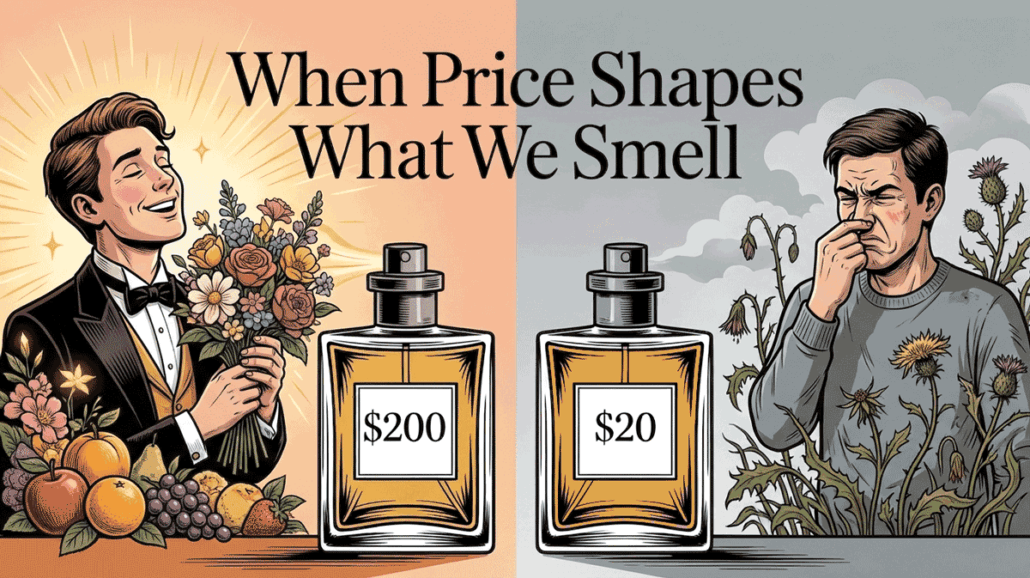
We often believe that our senses provide a direct and reliable experience of the world. When something smells pleasant, we assume the pleasure comes from the object itself. Yet research in sensory science reveals a more complex reality: expectation, context, and perceived value can influence how we experience smell and taste. One of the most striking demonstrations of this phenomenon comes from a famous experiment showing that the same wine can be perceived as better simply because people believe it is more expensive.
Is Sensory Perception Really Objective?
Most of us think of smell and taste as immediate and objective senses. A fragrance smells good because its composition is good. A wine tastes refined because of the quality of the grapes or the skill of the winemaker.
Yet human perception rarely works in such a simple way. What we experience through our senses is constantly shaped by context: what we see, what we read, what we expect, and even what we believe something is worth.
In other words, perception is not only a reaction to the stimulus itself. It is also influenced by the meaning that surrounds it.
Few experiments demonstrate this more clearly than a study conducted at the California Institute of Technology in the early 2000s.
The Experiment: When Price Changes Taste
In 2008, researchers Hilke Plassmann, Antonio Rangel, Baba Shiv, and John O’Doherty conducted a remarkable experiment exploring how price influences sensory experience 1
Participants were invited to taste several wines while their brain activity was monitored using functional MRI. Each wine was presented with a price label. Some bottles were described as inexpensive, while others were presented as premium wines with significantly higher prices.
The participants carefully tasted the wines and rated how pleasant they found each one.
What they did not know was that some of the wines were exactly the same. The liquid in the glass had not changed at all. Only the price information had been altered.
Yet the results were clear and consistent. When participants believed the wine was expensive, they reported enjoying it more. The identical wine tasted better simply because they expected it to be better.
The sensory experience itself had changed.
What Happened in the Brain
The most fascinating part of the experiment appeared in the brain imaging results. When participants tasted wines they believed to be more expensive, activity increased in a region of the brain known as the medial orbitofrontal cortex.
This area is closely associated with the experience of pleasure and reward. In other words, the brain was not merely reporting that the wine should be better. It was genuinely experiencing it as more pleasant.
Expectation had altered the neural experience of taste.
This finding suggests that perceived value—such as price or prestige—can influence sensory pleasure itself. What we believe about a product can subtly reshape how we perceive it.
What This Means for Perfume
Although the experiment involved wine, the implications extend easily to perfume. Fragrance, like taste, is deeply connected to memory, emotion, and expectation.
Before smelling a perfume, we often encounter a narrative. We see the bottle, the brand name, the price, and the description. We read about rare ingredients, precious woods, or legendary flowers.
All these elements create a framework in the mind. By the time the perfume reaches the nose, the brain already has expectations about what should be experienced.
This does not mean that the fragrance itself is irrelevant. But it does mean that perception is rarely isolated from context.
In modern perfumery, where storytelling and branding often dominate communication, these expectations can strongly influence how a fragrance is perceived.
As discussed in Why natural perfumes are not linear, even the familiar structure of the olfactory pyramid can guide perception before the perfume has fully unfolded.
Rediscovering Direct Experience
Recognizing the influence of expectation does not mean rejecting all descriptions or narratives. Stories can enrich the experience of perfume. They can evoke images, memories, and emotions.
But it can be valuable to occasionally set those stories aside and return to the simple act of smelling.
Without the pressure to confirm expectations, the fragrance can reveal its own rhythm. Subtle nuances appear. Unexpected facets emerge. The perfume becomes less a confirmation of what we were told and more a discovery.
This approach connects naturally with the idea explored in wearing perfume as an act of listening. Instead of interpreting the fragrance immediately, we allow it to unfold in time and attention.
When this happens, something interesting occurs. The perfume stops being a product that we evaluate and becomes an experience we inhabit.
And in that moment, the nose is finally allowed to speak before the mind decides what it should smell like.
SEE ALSO:
Natural Perfume is not a product: it is a Relationship
When the Brain Smells Before the Nose
Olfactory Pyramids: Understanding the Nonlinear Nature of Natural Perfumes
1. Marketing actions can modulate neural representations of experienced pleasantness, Hilke Plassmann, John O’Doherty, Baba Shiv, and Antonio Rangel, 2008
Abstract: Despite the importance and pervasiveness of marketing, almost nothing is known about the neural mechanisms through which it affects decisions made by individuals. We propose that marketing actions, such as changes in the price of a product, can affect neural representations of experienced pleasantness. We tested this hypothesis by scanning human subjects using functional MRI while they tasted wines that, contrary to reality, they believed to be different and sold at different prices. Our results show that increasing the price of a wine increases subjective reports of flavor pleasantness as well as blood-oxygen-level-dependent activity in medial orbitofrontal cortex, an area that is widely thought to encode for experienced pleasantness during experiential tasks. The paper provides evidence for the ability of marketing actions to modulate neural correlates of experienced pleasantness and for the mechanisms through which the effect operates.










Leave a Reply
Want to join the discussion?Feel free to contribute!