
Olfactory Pyramids: Understanding the Nonlinear Nature of Natural Perfumes
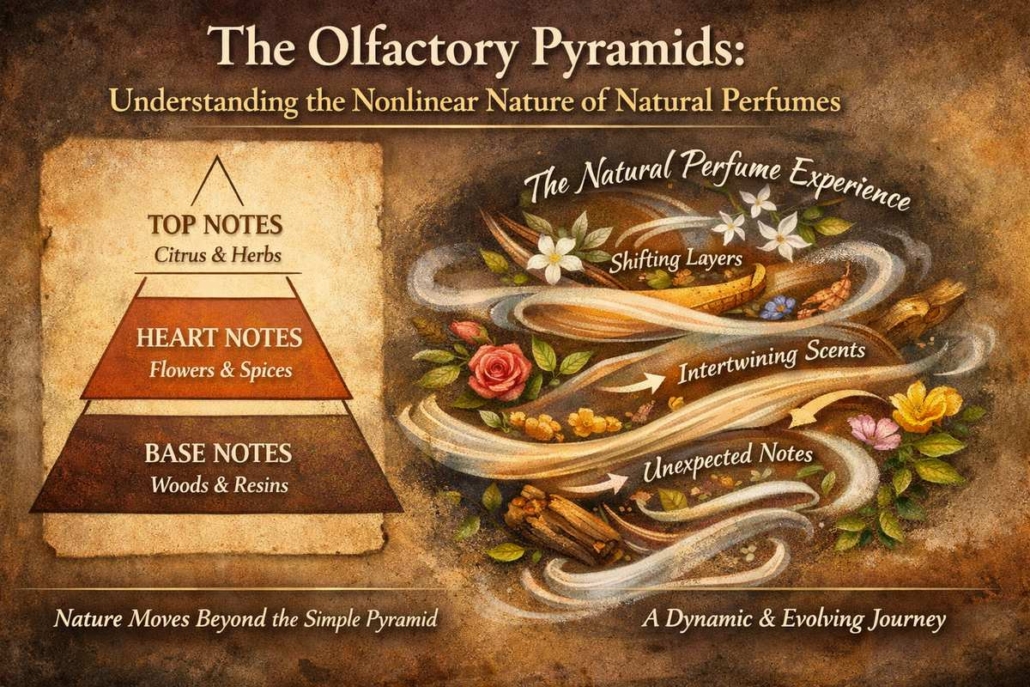
The familiar language of modern perfumery describes fragrance as a sequence: an opening that appears first, a heart that follows, and a base that remains. This model, often depicted as the “olfactory pyramid,” suggests that perfumes unfold in a predictable, orderly way. Natural perfumery tells a different story. When working with living materials—resins, woods, flowers, and roots—scents do not behave like a rigid structure. They move, overlap, return, and sometimes surprise us. Understanding this difference helps reveal why natural perfumes cannot truly be reduced to a simple pyramid.
The Seduction of the Olfactory Pyramid
For decades the perfume industry has described fragrance using a simple diagram: the olfactory pyramid. At the top are the so-called opening notes, bright and volatile. In the middle sits the heart, which supposedly defines the character of the perfume. At the base lie the deep notes that give longevity and persistence.
This model is easy to understand and easy to communicate. It suggests order, balance, and clarity. More importantly, it offers a reassuring promise: that perfume behaves according to a predictable plan.
But this reassuring simplicity hides an important truth. In many cases the pyramid does not describe how the perfume actually behaves. Instead, it describes how the perfume is marketed.
Lists of notes printed under these pyramids rarely correspond to real ingredients. A word like “oud” may refer not to oud essential oil but to a synthetic accord designed to evoke a familiar idea of oud. In other words, the pyramid often invites us to imagine a perfume rather than to perceive it directly.
Why Natural Essences Refuse Fixed Layers
Natural essences do not obey rigid categories. They rarely neatly fit into a single layer of a pyramid.
Rose essence, for example, can act as both a top note and a heart note. Its brightness appears quickly, yet its warmth can remain long after other materials have faded. Tobacco can behave as both a powerful heart and a base note, capable of dominating an entire composition even when used in very small quantities.
Some materials are even more complex. Angelica root is a well-known example. It can appear immediately, persist through the middle of the perfume, and remain present deep in the base. A tiny amount may influence the entire life of the fragrance.
These materials refuse to behave as the pyramid commands. Their aromatic life cannot be confined to a single moment in a timeline.
When Notes Overlap Instead of Following
In natural perfumes, scent rarely progresses through strict stages. Instead of a sequence—first this, then that—there is often a field of overlapping presences.
A citrus may appear brightly at the beginning, yet remain faintly alive later. A resin may feel distant at first, but slowly grows stronger as warmth releases its depth. A floral note might move in and out of perception depending on movement, temperature, or attention.
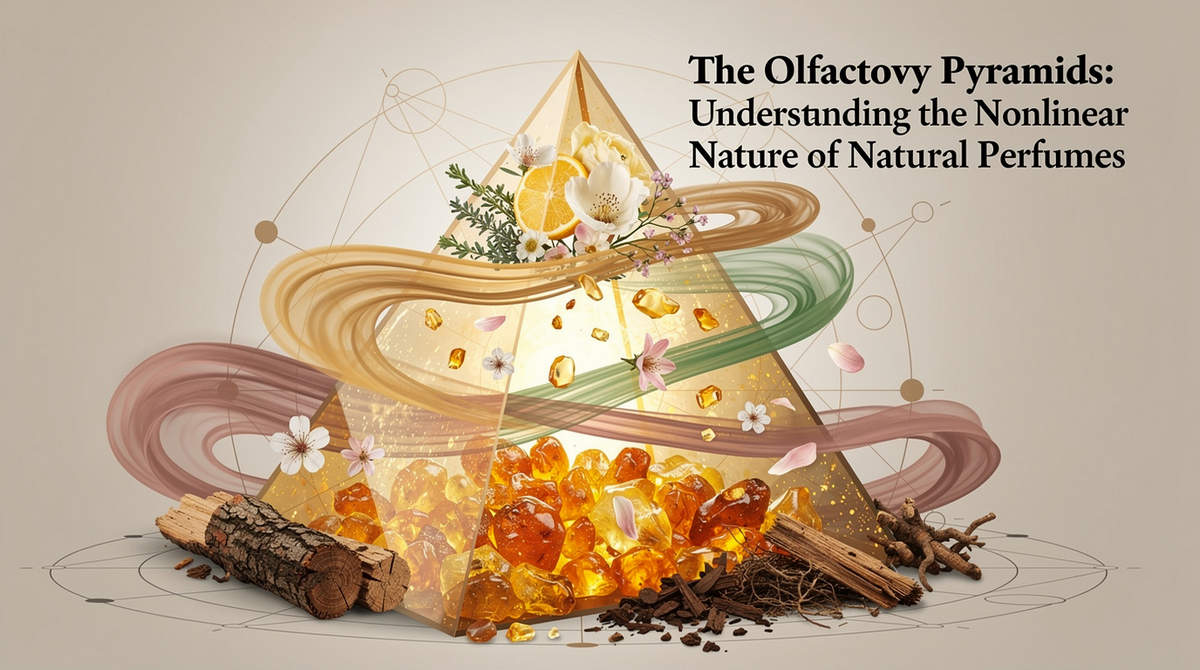
Rather than a pyramid, the experience resembles a landscape. Some elements come forward while others recede. What was subtle may suddenly become clear. What seemed dominant may dissolve quietly into the background.
The perfume is not following a rigid script. It is unfolding as a living interaction between materials, skin, and time.
How Pyramids Shape What We Think We Smell
The power of the pyramid lies not only in how it describes perfume but also in how it influences perception.
Once we read that a perfume contains lavender, amber, or musk, our imagination becomes involved in the experience. We begin to search for those elements. Sometimes we even believe we smell them clearly, whether they are present or not.
Human perception is easily guided by expectation. Studies in olfaction repeatedly show that the brain often leads the nose. If we are told to expect a particular scent, we may recognize it even in its absence.
The Famous “Red Wine That Was White” Experiment
A well-known experiment in sensory science illustrates how strongly expectation can influence what we believe we smell. In 2001, researchers Frédéric Brochet, Gil Morrot, and Denis Dubourdieu conducted a study that has since become famous in the field of olfactory perception 1.
In the experiment, a group of trained wine tasters was invited to evaluate what appeared to be a red wine. The participants carefully smelled and described the aroma using the vocabulary typically associated with red wines: notes of cherry, berries, tannins, and dark fruit.
But there was a detail the tasters did not know.
The wine they were smelling was not red at all. It was a white wine that had been colored red with an odorless dye.
Despite their training and experience, the participants consistently described aromas typical of red wine. None of them identified the wine as white. Their perception had been guided not only by the smell itself but also by the visual expectation created by its color.
The study’s conclusion was striking: even trained experts can have their sensory perceptions shaped by contextual cues and prior expectations. In other words, what we believe we perceive is not always determined solely by the stimulus reaching the nose.
This phenomenon explains why perfume descriptions can be so persuasive. They build an image in the mind before the nose has had the opportunity to explore freely.
This phenomenon helps explain the persuasive power of note lists and olfactory pyramids in modern perfumery. When we are told that a fragrance contains lavender, amber, or musk, our mind naturally begins to search for those elements. And sometimes, the brain confidently “finds” them—even when they are not truly present.
The nose, in other words, rarely works alone. The brain is always part of the experience.
Perfume as a Living Movement in Time
Natural perfume does not follow a rigid pyramid because it is not constructed as a mechanical sequence. It behaves more like a living movement in time.
Materials interact with warmth, breath, humidity, and motion. What appears first on one person may appear later on another. What seems quiet in the morning may become radiant in the afternoon.
This is why the experience of natural perfume often requires patience. Its beauty may not reveal itself instantly. Instead, it appears gradually, sometimes unexpectedly, through continued presence.
This relationship with time is explored more deeply in Why Some Perfumes Take Time, where the unfolding of scent is understood as part of the encounter itself.
Learning to Experience Perfume Without the Pyramid
Letting go of the pyramid can be surprisingly liberating. Without a predefined map, the nose becomes free to observe what is truly happening.
Instead of asking whether we detect the notes listed in a description, we can ask simpler questions. How does the perfume move? What changes over time? Which sensations return after disappearing?
This kind of attention transforms the act of wearing perfume. It becomes less about confirming expectations and more about experiencing presence.
Approaching fragrance in this way naturally connects with another important idea: wearing perfume as an act of listening. When we listen rather than analyze, we allow the perfume to reveal its true rhythm.
Natural perfumes are not puzzles designed to be solved through diagrams. They are living compositions meant to be experienced through time, with attention, and repeated encounters.
Frequently Asked Questions
What is an olfactory pyramid?
An olfactory pyramid is a simplified model used in modern perfumery to describe fragrances through top, heart, and base notes. While widely used in marketing, this structure often fails to represent the complex behavior of natural perfume materials.
Why are natural perfumes not truly linear?
Natural essences rarely behave as isolated top, middle, or base notes. Many botanical materials overlap multiple stages simultaneously, evolving in fluid and unpredictable ways rather than following a rigid sequence.
Can the notes listed in a perfume pyramid be misleading?
Yes. In commercial perfumery, listed notes often describe imagined accords rather than actual natural ingredients. A “rose note” or “lavender note” may not contain real rose or lavender extracts at all.
Why do people sometimes smell notes that are not actually present?
Olfactory perception is strongly influenced by expectation, suggestion, memory, and language. When people read a fragrance pyramid before smelling a perfume, their brains may anticipate certain notes, thereby influencing perception.
Do natural perfumes evolve differently on the skin?
Yes. Natural perfumes interact dynamically with skin chemistry, body temperature, humidity, and air exposure. Their evolution is often more fluid and multidimensional than highly standardized synthetic compositions.
Why does natural perfumery challenge conventional fragrance marketing?
Natural perfumery emphasizes complexity, transformation, and direct sensory experience rather than simplified marketing structures. It invites people to encounter perfume through perception rather than relying solely on predefined descriptions.
Editorial Note
This article is part of the educational resources of Natural Niche Perfume. It was written by our editorial team in accordance with the philosophy and principles of natural perfumery developed by AbdesSalaam Attar.
See also
Essential Writings of AbdesSalaam Attar
Pyramids, Lies and Myths of Modern Perfumery
Why the Same Perfume Smells Different on Every Person
- The Color of Odors, Gil Morrot, Frédéric Brochet, Denis Dubourdieu









Leave a Reply
Want to join the discussion?Feel free to contribute!