What is an Attar?

Table of contents
-
What is attar?
-
History of attar
-
Types of attars
-
Uses of attars
-
How to wear attars
-
Life of attars
-
Final words
Whether it’s a festival, a ceremony, a function, a ritual, or a celebration that matters most to the people, attar, or fragrance, is essential for everyone. Attars have been used since the early human civilizations.
“No elegance is possible without perfume. It is the unseen, unforgettable, ultimate accessory.” – Coco Chanel, French fashion designer and founder of the world-famous fashion brand “Chanel”.
Attars are respected as an identity of majesty, honor, and glory. Attars were widely studied and developed under the Islamic dynasties such as the Nasrid kingdom of Spain, the Ottoman Empire, the Mughal Empire, and more.
Attars are typically essential oils or absolutes derived from natural sources. In general, these essential oils are extracted by steam or hydrodistillation. Technically, attars are extracts of natural flora and fauna.
Essential oils are distilled into a wooden base, like sandalwood, and left to age. The aging period can range from 1 to 10 years, depending on the natural sources used and the desired outcome.
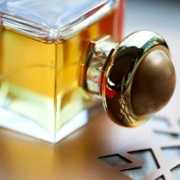
Attars are basically highly concentrated perfumes, free from alcohol and synthetic chemicals. These natural perfumes are offered for sale in very small quantities, poured in small and decorated or sometimes jeweled traditional decanters.
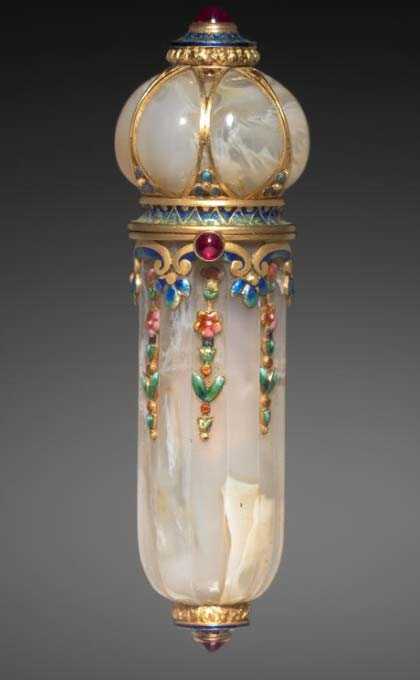
Cleveland Museum of Art c. 1900 fabricated by Tecla Firm (French), agate with enamel, gold, and rubies.
History of Attar
The word “attar”, “itra”, or “ittar” is commonly assumed to have been derived from “itir”, a Persian word that means perfume, which is, in turn, came from the Arabic word “itr”.
The story of attar is as ancient as human civilization itself. Studies have shown that the earliest methods and techniques for producing essential oils were developed by Ibn al-Baitar (1188 CE – 1248 CE), an eminent chemist and physician in Muslim-ruled Spain, within the Emirate of Granada.
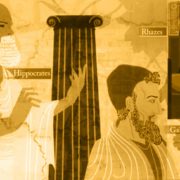
The Egyptians were reputed for making perfumes across the ancient world. These perfumes were formulated from flowers and plants before being mixed with other oils. Later, a renowned physician of the Islamic Golden Age, Abu Ali al-Sina (980 CE – 1037 CE), also known as Ibn Sina (Avicenna), refined and developed the methods and made distinctive and diverse types of attars. He is believed to be a pioneer who used distillation techniques for roses and other plants.
Ibn Sina first discovered the process of making rose water, and his popularity spread throughout the world. He formulated more than 60 cardiac medicines, and in most cases, he used attars. He used several attars for making his medicines, including attar of oud, attar of jasmine, attar of saffron, and attar of roses.
The Yemeni Queen Arwa al Sulayhi (1048 CE – 1138 CE) introduced a special variety of attars derived from mountainous flowers. She used to gift these attars to the monarchs of Arabia.
In the Mughal Empire, Abul Fazal Faizee, the grand vizier of Emperor Akbar, introduced the Mabkhara incense burner. Diverse types of herbs such as Aloe (Oud), Cinnamon, and Sandal and animal substances such as Anbar, Musk, and Myrrh were used for producing attars in the Mughal reign.
Types of Attars
Based on effects on the human body, attars can be classified into 2 types –
- Cool attars – these attars have a cooling effect on the human body and are typically used in summer. For instance, jasmine, rose, mogra, khus, and kewda are considered cool attars.
- Warm attars – these attars are believed to enhance body temperature; therefore, they are commonly used in winters. Examples of warm attars include Saffron (in India called Kesar), amber, and musk.
Besides, based on the sources used, attars can be classified into several types:
Floral attars: these attars are derived from the extracts of a single species of flower. Some examples of floral attars include
- Rose
- Jasmine
- Jasmine Sambac (in India called Mogra)
Herbal attars: these attars are made by blending several essential oils derived from botanical sources such as flowers, leaves, spices, fruits, roots, or stems.
“Mitti” attars – these attars are distillates of baked soil over liquid paraffin or sandalwood essential oil via water distillation techniques, sometimes using Ganges river water.
Animal scents – these attars are derived from animal substances such as pheromones. These attars are also natural perfumes but fall in the non-vegan category. For example, musk and ambergris are animal scents.
- Musk – musk is derived from the glandular secretions of a rare species of male deer, especially found in the Himalayan regions.
- Ambergris – Ambergris is derived from an aromatic substance released by sperm whales, the largest toothed animal in the world.
In the past, attars were used only by the elite, especially kings, queens, and high-ranking political officials. But in modern times, attars can be worn by almost everyone as special attire.
Some common uses of attars include the following.
- Most commonly, attars are used as a perfume, especially in Muslim communities due to the absence of alcohol.
- Attars are used in the pharmaceutical industry to make medicines, especially for cardiac and aphrodisiac purposes.
- Attars can be used in several complementary therapies, such as aromatherapy and spa therapy, to improve pain, cardiac, migraine, and respiratory health. It also helps in improving emotional health conditions like stress and depression.
- Attars are used to make luxurious dishes and sweets, imparting delicious flavors in the Middle East and South Asian countries.
- Attars are widely used in chewing tobaccos such as pan masala and gutka to suppress tobacco notes.
- Attars are used in the perfumery industry to create exotic varieties of perfume.
- Due to their alluring, natural aromas, attars are used to make various scented products, including cosmetics, candles, room fresheners, and incense sticks.
Attars can be used in various ways depending on the purpose. Different reasons tend to apply attars differently.
Here are some common methods for using attars –
- As a perfume, you can dab attar on your wrists, earlobes, or other parts of your body. Attar may stain your clothes; hence, it’s recommended to take attar on your fingertips, rub it into your palm, and then run your hands over your clothes instead of applying it directly.
- In aromatherapy, attars can be used in diffusers to inhale the smells. Or it can be added into massage oils.
- A very small amount of attar can be added in the preparation of delicious and luxurious dishes.
Attars have an extremely long shelf-life and don’t need any preservatives. Some pure attars become stronger over time and, obviously, more costly. Therefore, antique attars are sold at premium prices.
Attar is a part of various human cultures. It improves mood and confidence and sometimes helps to enhance our healing process. But when you wish to use an attar, make sure you choose a natural and non-toxic attar so that you can get the maximum benefits without any harmful effects.






Good article!